Site Energy & infrastructure
Tilt Renewables
A renewable energy generator with 21 wind, solar and battery projects, each needing its own small website. We rebuilt their WordPress site so the team can edit all of it, with each editor limited to the pages they are allowed to change.

- Client
- Renewable energy generator, Australia
- Industry
- Energy & infrastructure
- Shipped
- 2026
- Live at
- Coming soon
Before
Not slow, but painful to change.
Tilt Renewables develops and runs wind farms, solar farms and batteries across Australia. Each project has its own content: planning documents, community pages, newsletters, benefit programmes, and regulatory filings that must stay at a fixed web address. The WordPress site had never been built for that. Each project page was stored in one catch-all content field, and its sub-pages sat at the top level of the site instead of under the project. Images and files were stored on two different servers, and other software could not even read the projects through WordPress's API. Updating one project meant a developer, or a very patient editor.
The site loaded in 1.6 seconds, so speed was not the complaint. Structure was. A team of twelve people needed to edit it, and not everyone should be able to change everything.
What we built · 01
Every project is its own small site.
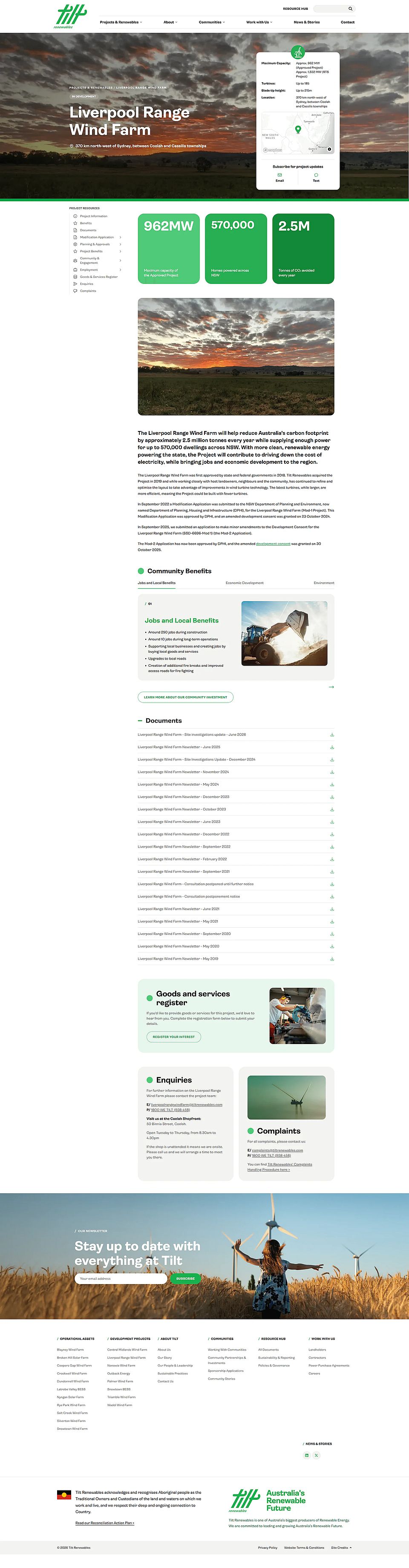
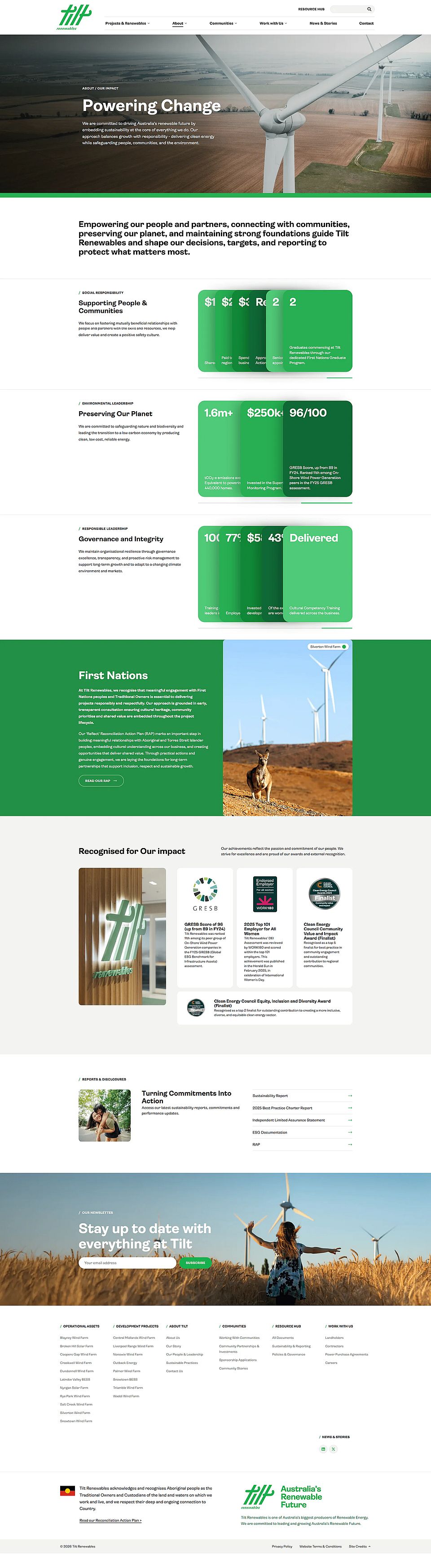
The new site is built with Astro, which prepares every page in advance. It is hosted on Cloudflare and edited in CloudCannon, a visual editor. Each of the 21 projects has its own folder: a project home page with key facts, a location map, stages, stats, a gallery and documents, and proper sub-pages underneath it (planning and approvals, community, benefits). Each sub-page has a fixed address that regulators can cite. Every project gets its own sidebar menu, which also links to the sections of the page you are on. A newsletter switch turns any sub-page into a dated newsletter with its own archive.
Scripts moved the news archive, the 21 projects and the leader bios across, with redirects so that no link to the old site stops working.
What we built · 02
Who can edit what.
Twelve people edit the site, at three levels of access. Some can edit all of it. Some can only change news and projects. Some can change everything except the project pages. Four publishers, and only those four, can put changes live. All editing happens on a private copy of the site. The live site is locked and only accepts changes once someone has reviewed them.
The permission groups use CloudCannon's file permissions, set folder by folder, so a project added next year gets the same restrictions. A script sets the groups up, so they can be recreated in a minute rather than clicked together again.
What we built · 03
A document library nobody has to maintain.
Every project has its own documents: planning applications, approvals, newsletters, community reports. The Resource Hub brings more than 700 of them, from 19 projects and seven document types, into one library that visitors can filter, search and share links to. Nobody maintains it. The hub is put together from the project pages each time the site is rebuilt, including the rebuilds editors start from CloudCannon, so it is never out of date. A check warns if a document is ever placed where the hub can't find it.
The same rebuild updates the site search, writes the sitemap and llms.txt files that search engines and AI tools read, and optimises every image, a step editors can't skip by pasting in a direct link. Documents and videos are stored in Cloudflare R2, a file library the team uploads to from inside CloudCannon.
Before and after
The same pages, measured.
The old site was not slow, so the gain is smaller than on most rebuilds. It is still three times faster, with a perfect performance score, on a site with far more in it.
GTmetrix grade
- Before
- B
- After
- A
Performance score
- Before
- 87
- After
- 100
Fully loaded
- Before
- 1.6s
- After
- 549ms
Homepage tested with GTmetrix in September 2026, from the same location and device both times.
What changed
The numbers.
3×
faster
fully loaded in 549 ms, from 1.6 s, with a perfect performance score
21
project mini-sites
each with its own pages, sidebar, documents and newsletter archive
700+
documents in one resource hub
collected from 19 projects automatically on every update
3
access levels
twelve editors in four permission groups, publishing rights kept separate
300+
redirects
every old WordPress address still leads to a page
Counts from the build, September 2026. The site keeps growing as the team publishes.
Runs on
No lock-in.
The code lives in Tilt's own GitHub organisation, the site in their own CloudCannon organisation and Cloudflare account, and every document in their own R2 storage. The permission groups are a script they hold. If we disappeared tomorrow, the team would keep editing.
- Astro
the site, every page built ahead of time in about four minutes
- CloudCannon
visual editing, a test copy, publishing and the four permission groups
- Cloudflare
hosting on Workers, plus the R2 document library
- Pagefind
search across every page, updated every time the site is published
- Mapbox
the location map on every project
- Basin
handles the four forms
Same Oven
More work like this.
Same Oven