Store AI Automation Health & ecommerce
Quitine
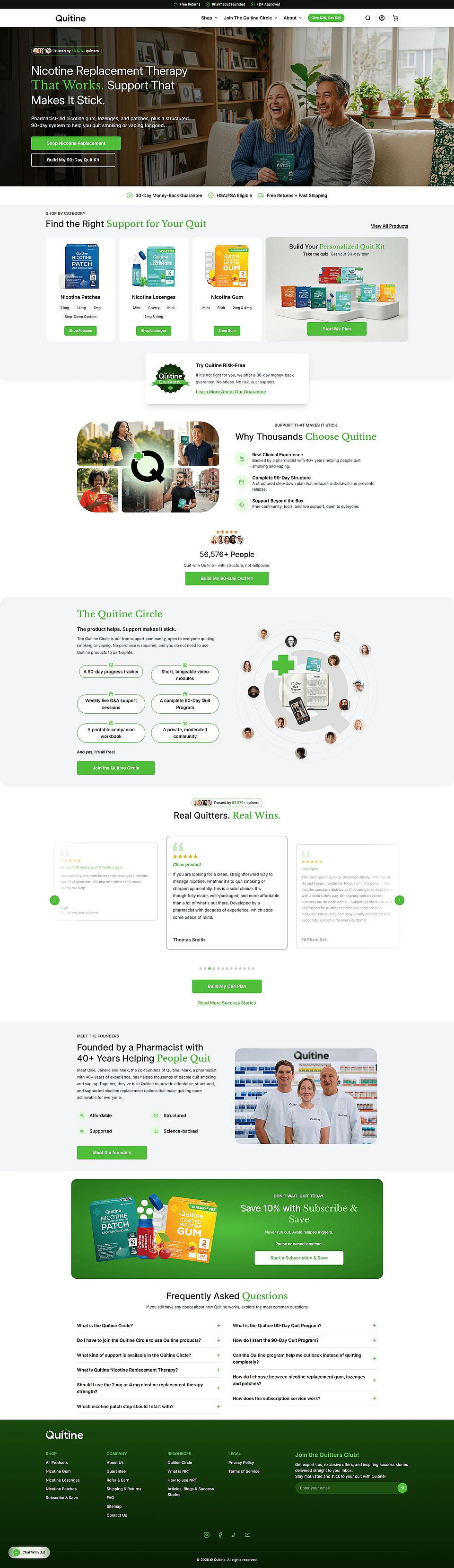
A nicotine replacement brand that outgrew its Shopify theme. The client brought the design. We built the custom store underneath it, with Shopify still running the checkout, and a way to run the whole site by asking Claude.
- Client
- Pharmacist-founded nicotine replacement brand
- Industry
- Health & ecommerce
- Shipped
- 2026
- Live at
- quitine.com
Before
A Shopify theme can only do so much.
Quitine sells pharmacist-led nicotine gum, lozenges and patches, with a 90-day plan behind them. The store ran on a Shopify theme, a ready-made design template, and the theme had become the limit. The client wanted to publish a landing page in an afternoon, control every element on every page, and launch things a theme does not allow: a quiz that builds a kit and goes straight to checkout, pages without the usual menu and footer for visitors from ads, and A/B tests that compare two versions of a whole page.
The design came from the client's own team. Our job was everything underneath it: the store, the content system, and the way it gets edited.
What we built · 01
A custom storefront, with Shopify behind it.
We built the storefront with SvelteKit, on Cloudflare. Shopify still handles products, cart, checkout, customer accounts and subscriptions. Everything else moved to Sanity, a content editor, including the articles from the Shopify blog, brought across with their addresses redirected.
Pages are built from more than 40 blocks in four layers, from the smallest pieces up to whole sections: atoms into molecules into wrappers into sections. Each block is defined once in Sanity and once in the site's code. The same blocks make a product page, a resource article, or a listicle: a stripped-back landing page for visitors from ads, with an offer or a quiz that ends in checkout. The Quit Quiz scores answers into nine outcomes with tiered discounts, and the kit builder prices a bundle live as it is put together. A/B tests run on whole pages: a second version in Sanity, a switch in PostHog, the analytics tool, and the split decided on the server before the page is sent.

Design by Quitine's team. We built what runs it.
What we built · 02
Run by asking Claude.
The client did not want to learn new editing software. He wanted to say what he needed. So he edits the site through a Claude skill we wrote, a set of instructions telling Claude what the site is made of: every block and every field, how a page is put together, how the quiz works, and how tracking and A/B tests are set up. It sits in his own Claude, next to the Sanity MCP, a connection that lets Claude read and change the content, and a small MCP of ours that uploads images. Together they turn a request into the work. New landing page for a campaign. Duplicate this page and change the top section. Add three FAQs. Import this article with its images. Set up a test on the homepage.
The rules are in the skill: read before writing, save drafts first, publish only when he confirms, never invent a field, and ask before touching anything shared. It also says plainly when a request needs a developer, which is rare. When the content structure changes, the skill is updated with it, so Claude never works from an old version of the site.
What changed
The numbers.
Double
digit growth in sales
since the move off the theme, by the client's count
0
developers needed for a new landing page
the client asks Claude: it drafts, then publishes when he confirms
40+
building blocks
from the smallest pieces to whole sections, all editable by asking
0
code changes to run an A/B test
a variant page in Sanity and a PostHog flag, split on the server
The sales figure is the client's and is published as a range on purpose. Counts from the code, September 2026.
Runs on
No lock-in.
The Shopify, Sanity and Cloudflare accounts all belong to Quitine, and Claude runs on the client's own subscription. The skill is a folder in the site's code repository, so the next person to work on the site gets the same instructions the client uses.
- SvelteKit
the storefront, on Cloudflare Workers
- Shopify
products, cart, checkout, customer accounts, subscriptions
- Sanity
every page and article, with click-to-edit preview
- Claude
the editor, through our skill and the Sanity MCP
- PostHog
analytics and the A/B split
- Klaviyo
email, quiz results and abandoned-cart reminders
Same Oven
More work like this.
Same Oven