NDIS websites Health providers
Websites and online stores for NDIS and health providers.
We build websites everyone can use, to the WCAG AA accessibility standard, and online stores that stay up when they're busy. Participants, families and therapists find what they need, and your own team updates it without a developer.
- Run by asking Claude
Double
digit growth in sales
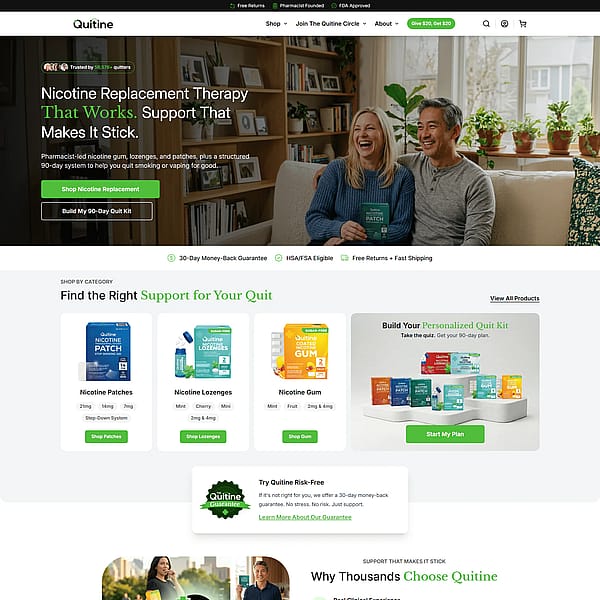
Quitine · since the move off its Shopify theme, by the client's count
2 → 1
stores merged into one
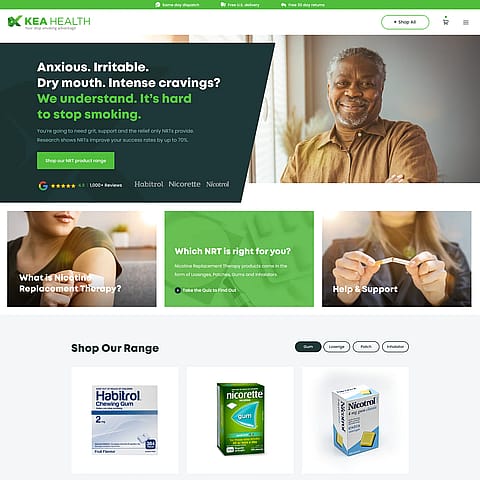
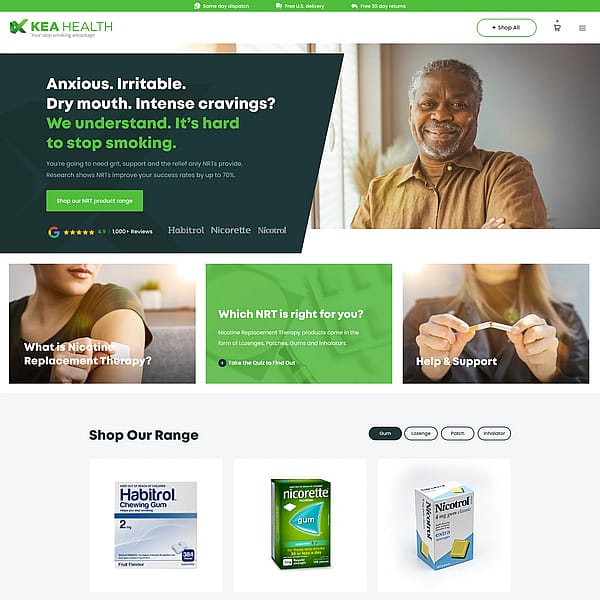
Kea Health · every old address redirected
100+
advice articles published by the team
Kea Health · without a developer
0
developers needed for a new page
Quitine · the client asks Claude
What's the Problem?
Where health websites let people down.
Many of the people choosing a provider use a screen reader, larger text or a keyboard instead of a mouse. If they can't use your site, they'll choose a provider whose site they can use.
The decision is often shared between the participant, a family member or carer, and a support coordinator or therapist. Each of them needs different information, and any of them may be the one who sends the enquiry.
Online stores get busy in bursts. Some of the stores we've rebuilt crashed or slowed to a crawl at exactly those moments, and lost orders while they were down.
And the buyer isn't always the payer. Some participants pay by card, some through a plan manager who pays an invoice, and some through the NDIS itself, which only registered providers can claim from.
Today's Menu
What we build for NDIS and health providers.
Each of these runs at a health business today: an NDIS-registered provider, and two stores selling pharmacist-led quit-smoking products.
An equipment store that stays up
For providers who sell mobility aids, home-care equipment or assistive technology.
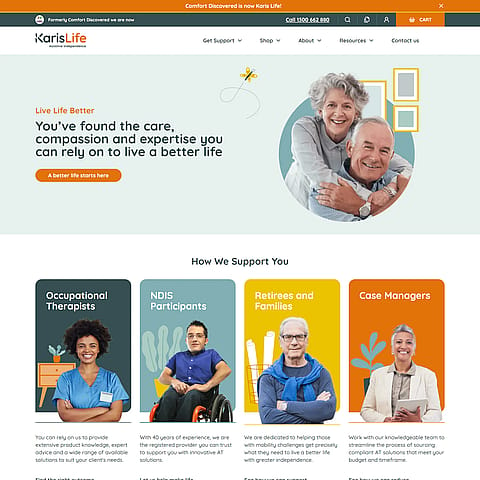
Shopify runs the products, the checkout and customer accounts, behind a storefront built for phones. Prices and stock come from Shopify as each page loads, so they're never out of date. Anyone can build a list of favourites and share it by link, which helps when a carer or an occupational therapist chooses for someone else.
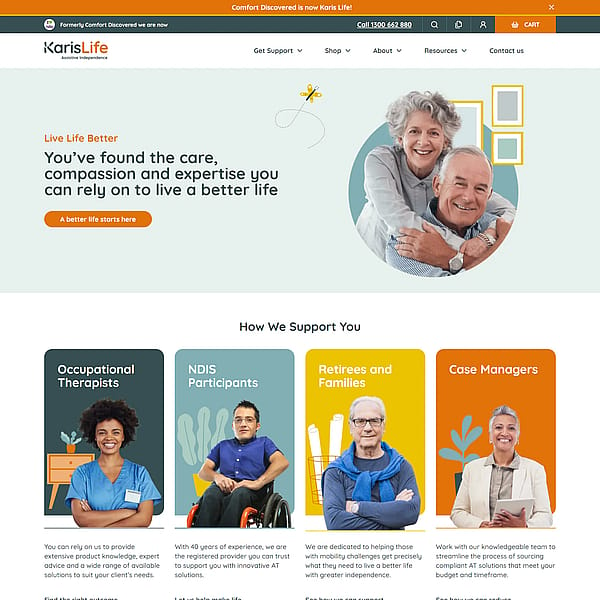
A mobility aids retailer and NDIS-registered provider since 2013, whose WooCommerce store crashed when it got busy. It now runs on headless Shopify, and the team edits its NDIS section, guides and seminars in Sanity.
- 01 A person
A therapist builds a shortlist
of chairs or walkers, as a favourites list on the store.
- 02
The list is shared by link
with the participant or their family, who see the same products, prices and stock.
- 03
The order goes to checkout
the store's cart hands over to Shopify's checkout in one step.
- 04
New products reach search engines
the day they're added in Shopify, through a sitemap built from the live product list.
The resultThe store stays up when it's busy, and a shortlist travels from therapist to family in one link.
Subscriptions and advice in one store
For health brands whose customers buy again every month.
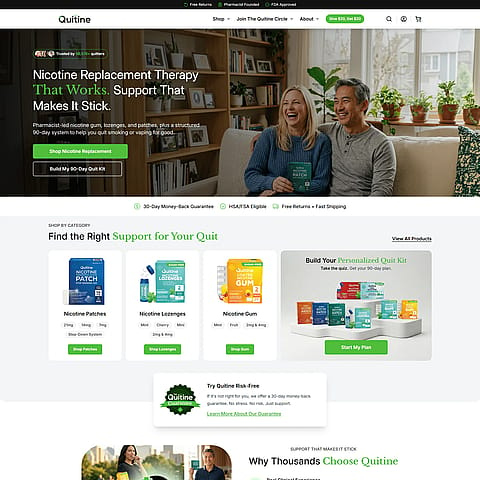
Customers buy once or subscribe, read reviews from verified buyers, and take a short quiz that points first-timers to the right product. The advice library is part of the same site, so a reader can go from an article to the product it mentions.
A family-run nicotine replacement retailer whose pharmacists give free guidance to people trying to quit. Its store slowed down whenever traffic surged; we rebuilt it, merged a second store into it, and its team has since published more than a hundred advice articles.
- 01 A person
A first-timer takes the quiz
and is pointed to the right product.
- 02
They buy once or subscribe
through Shopify's own subscriptions, with verified reviews beside the price.
- 03
Follow-up emails go out
from Klaviyo, the store's email tool.
- 04 A person
Questions reach one inbox
in Gorgias, where the team answers them.
The resultOne store handles first orders, subscriptions and advice, and stays fast when traffic surges.
A store run by asking Claude
For health brands that publish often and don't want a developer for every page.
The owner types what he needs into his own Claude: a landing page for a campaign, three new questions on a page, an imported article. Claude follows instructions we wrote for the site, builds it as a draft, and nothing is published until he says yes.
A pharmacist-led nicotine replacement brand that outgrew its Shopify theme. Sales are up by double digits since the move, by the client's count.
- 01 A person
The owner asks
for a campaign landing page, in his own Claude.
- 02
Claude follows our instructions
the site's building blocks, its fields, and what may be changed.
- 03
A draft appears in Sanity
where the site's content lives. Nothing is live yet.
- 04 A person
He checks it and publishes
only once the draft looks right.
The resultNew pages need no developer, and nothing goes live without the owner's yes.
Baked In
Included in every health website.
-
Accessible to WCAG AA.
Readable colour contrast, everything usable with a keyboard, and headings and labels a screen reader can follow.
-
Written for three readers.
Clear paths for participants, for families and carers, and for coordinators and therapists.
-
A referral form that asks the right questions.
Coordinators send a referral with the details you need to reply, in one go.
-
Supports matched to plans.
Each support you offer, with the NDIS support category it falls under, so participants and coordinators can match it to a plan.
-
Your credentials where people decide.
Registration, ABN, qualifications and the areas you cover, on the pages people read before they call.
-
Stays up when it's busy.
Pages are served ready-made or straight from Shopify, so a rush of visitors doesn't take the store down.
-
Edited by your team.
Add a service, a guide or a seminar without calling us.
-
No lock-in.
The store, the code and the editor are in your own accounts, and none of it needs us to keep running.
Connected for health clients so far.
Every name here is connected on a health site we built.
- Shopify
- Sanity
- Klaviyo
- Mailchimp
- Judge.me
- Gorgias
- PostHog
- Google Maps
- Claude
Software we haven't connected yet, such as Cliniko, connects through its API, and we confirm what it allows before quoting.
Fresh Out
Built for health providers.
Price List
What it costs.
Price List
- Website build for an NDIS or health provider
- from $9,000 typically $9–18k
- Shopify store on a custom Shopify theme
- from $9,000 typically $9–16k
- Custom storefront on Shopify the headless build these three stores run on
- from $12,000 typically $18–35k
- GEO & SEO programme found on Google and named in AI answers · 3-month minimum
- from $1,000/month typically $1–2.5k a month
- Care plan monitoring, updates, small changes and a monthly speed report
- from $250/month
What affects the price:
- how many services, regions and kinds of page
- how many products we move across, and whether customers buy online
- connections to your other software, such as a CRM, email or practice software
- how much content has to be written or rebuilt
You get a fixed quote after a scoping call. For a first range, describe your site or store to our estimator.
Try the estimatorFair Questions
Questions providers ask.
Six questions we hear from NDIS and health providers. Have another one? Ask us.
How much does an NDIS website cost?
Specialist NDIS web designers advertise template sites from about $1,400 to $5,000, and for a provider who needs five pages and a contact form, that can be the right call. Our sites and stores cost more, as the price list above shows. They suit providers who sell equipment online, run several services or regions, or need a site that stays up when it's busy.
Is the website accessible for people with disability?
Yes. Every site we build meets the WCAG AA accessibility standard: readable colour contrast, everything usable with a keyboard, and headings and labels a screen reader can follow. We test each page in Google's Lighthouse before launch and fix anything it flags. Our own site scores 100 there.
Can participants pay through their plan manager?
Yes, if the store is set up for it. A Shopify store can take card payments and also accept an order to be paid later by invoice, so a plan manager pays you the way they pay any provider. Participants whose plans the NDIA manages can only use registered providers, who claim from the NDIS directly.
Do you do SEO for NDIS providers?
Yes, through the same programme we run for every client. That means a page for each support you offer, written the way participants and coordinators search, the technical fixes, and a monthly report of where you're found on Google and named in AI answers. It starts with a free audit.
Can our team update the site without a developer?
Yes. Pages are built from blocks your team arranges and previews before publishing. Karis Life's team publishes its own guides, seminars and NDIS pages, and Kea Health's has written more than a hundred advice articles.
What happens to our old store's links and rankings?
Every old product and page address is sent to its new page, so links keep working and search engines carry what you've built up across. We did it for every product on Karis Life's old store, and for two stores at once at Kea Health.
Also on the menu All industries
- eCommerce. Shopify stores, from a custom theme to a storefront of your own.
- Websites. Accessible websites that load in under a second, edited by your team.
- SEO & AI Visibility. Found on Google, and named when people ask ChatGPT or Claude.
- Shopify store inspector. See what your current store runs on and how fast it is for shoppers on phones. Free.
Made to Order
Tell us about your services.
A couple of lines is enough. After a short call, you'll get our recommendation and a fixed quote within a business day.